

This article is very important for long term investing
So read carefully.In this article, we will discuss the ups and downs in the path of investors in the journey of the stock market
In this part of the article, we will study some of the influences that affect our long term investment journey or we have to accept and understand them naturally.
Inflation
1-Stocks and inflation
Because in this long journey of stock market investment, we have many types of opportunities and many times many strange events affect the stock market, at that time we do not understand the incident and we think that it is a very big accident, but after some time we come to know that it was not an accident, in this event if the market had gone down too low So this was an opportunity for us to buy good stocks and we missed that opportunity
An investor should carefully understand the impact of inflation on the stock market. In this article, I will explain with examples how it is important to understand the importance of inflation.
Those who regularly invest in the stock market are always in touch with business channels. They pay close attention to inflation figures in the US. While many factors influence the stock market, as we all know, inflation is hard to ignore.
Because Indian markets often take cues from the US markets and fluctuate based on them, the impact of inflation on the US markets is as follows: When inflation rises, the Federal Reserve raises interest rates to control inflation. This negatively impacts the stock market: corporate borrowing costs rise, profits decline, investors turn to bonds, and stock valuations fall, causing the market to decline.
5Year US Inflation data vs S&P 500 performance
Now let’s present you with an analysis comparing US inflation data and the returns of the S&P 500 (which covers its 500 largest stocks) from 2020 to 2025.
| Year | Inflation | S&P 500 gain |
| 2020 | +1.2% | +18.4% |
| 2021 | +4.7% | +28% |
| 2022 | +8% | -18% |
| 2023 | +4% | +26% |
| 2024 | +2.9% | +25% |
In these figures, we have to see whether only inflation is affecting the stock market or not, many other factors are also playing their role here, for example, from 2020 to 22, there is also the recovery after Covid due to which the market was going up.
But we should take a look at the figures of 2022. In 2022, the rate of inflation had reached 8%, which was quite high, hence in front of inflation, all other issues were ignored in the market and negative of 18% was allowed to come in the market.
Effect of Inflation in Indian stock market
Generally, inflation figures in India do not affect the market much, but the increase in inflation in different ways has an impact on the stock market.
But if inflation increases too much, the Reserve Bank of India’s interest rate may increase. The main effects on the stock market when the RBI increases the interest rate (repo rate):
1-The stock market falls (Nifty/Sensex falls).
2-Corporate borrowing costs increase → profits decrease.
3-Investors become cautious → selling increases.
4-Rate-sensitive sectors like real estate, auto, and banking are most affected.
5- Fixed income/bonds become more attractive → money flows out of stocks.
Basically, the impact is negative, but less if the increase is anticipated.
Additionally, if a specific product becomes expensive and serves as an input for companies, the affected stocks also decline.
Effect of specific input material pricing (example crude oil)
The price of crude oil primarily has a negative impact because it increases companies’ manufacturing or service costs, which impacts their profit margins. These sectors include: Aviation (Airlines) ,Automobiles, Paints, Tyres ,Chemicals, FMCG (to a lesser extent) ,Logistics/Transport
Effect in pricing due to other reason Vs demand of product
Additionally, if a product becomes expensive for any reason, it is inevitable that the company’s stock will fall.
Example of ITC and Linde India
Recently, the government significantly increased taxes on cigarette companies, which led to a sharp decline in the stocks of these companies following this news.
For example, ITC is a cigarette manufacturing company. After the government increased the tax, (feb 2026)its shares fell. You can understand from the chart given below.
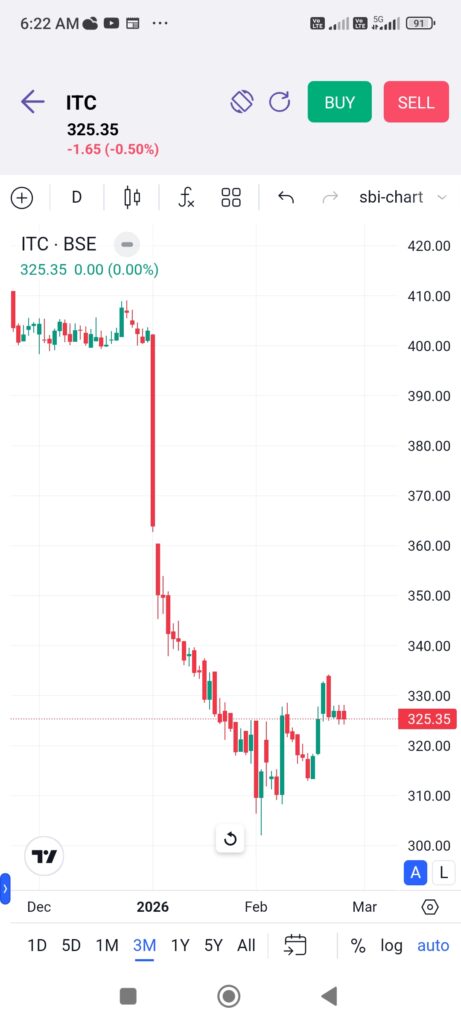
We all know that in such a situation, any company increases the price of its product and passes it on to the customers and the price of their product increases. If the investors feel that this product is very important for the customers and there will be no decrease in their demand despite the price increase, then the stock can recover in the long run.
And a drop in the stock could also be a buying opportunity for them.
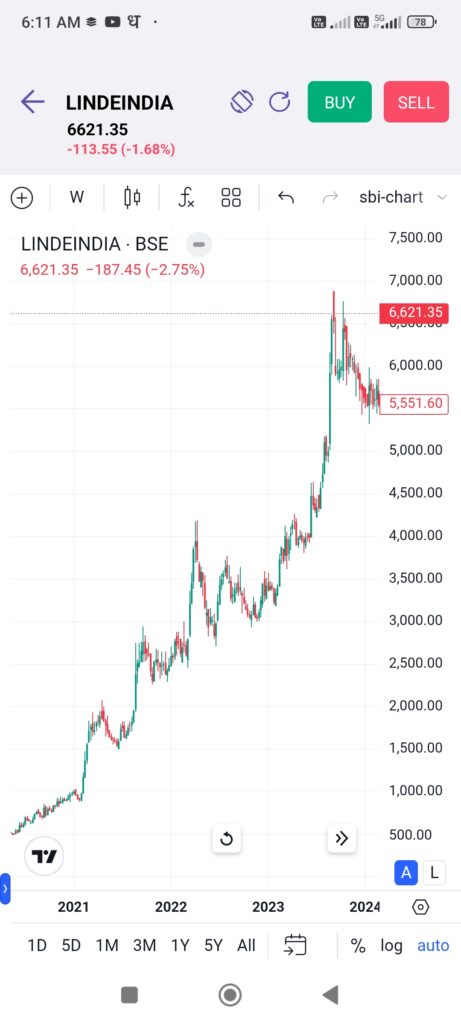
Conversely, if the price of a company’s product rises due to increased demand, it is forced to increase its stock prices. For example, we all know that during Covid, the demand for medical cylinders increased significantly, due to which Linde India had to even double the cylinder prices. Due to high demand, its stock saw a continuous upswing from 2021 to 23.
Precautions to be taken while maintaining the value of money through stock market due to inflation
We have studied the impact of inflation on the stock market or on a particular stock. We know that investing in the stock market can result in negative returns. This is a risk. But if our money is kept only in a savings account or in fixed deposits, it will give us a return of 2 to 7% per annum, which will reduce the value of our money in the long run.
People usually make FDs in banks to secure their money. However, with FDs in banks, we get annual returns of 6 to 7%, and the inflation rate is also close to or slightly lower than the this. Therefore, our money does not increase in proportion to inflation.
In such a situation, a person impressed by the share market invests his money in the stock market. Suppose he wants to invest his money in the stock market for 10 years and he has bought any stock and he hopes that he will get two to three times the return of the FD. If this happens then it is a very good thing, but the matter can turn out to be the opposite.
Let’s take an example. Suppose, 10 years ago, a person named A had ₹10,000. He decided that instead of investing this money in an FD, he would invest it in the stock market so that his money would triple or quadruple in the next 10 years. He invested his money in PC Jeweller without doing any research.
This stock has given a consistent negative return of 5% every year, hence the money lost by person A would have become Rs 5500 (from February 2016 to February 2026)
Suppose Person B had invested ₹10,000 after proper research and invested his money in Titan Company. In the last 10 years, this stock has given returns of 29 to 30% every year and the value of his money would have been ₹130,000 to ₹140,000 today (Feb 2016 to Feb 2026)
What I mean to say is that if we have money, then investing it in any stock is a wrong strategy. There is no guarantee that we will be able to retain its value in the long run against inflation if we invest in any stock. If this is better, then FD is the right option because if a person C had invested ₹10,000 in FD 10 years ago, then the value of his money would have become ₹18,000 to ₹20,000. FD gives an annual return of about six to seven percent (Feb 2016 to Feb 2026)
For this, it is important to keep a few points in mind:
1- One should not invest money in haste.
2-One should invest in good stocks only after thorough research.
3-One should keep getting fundamental information about stocks from time to time.
2-FII, DII promotor activity and effect of block deals
FII stands for foreign institutional investors and DII stands for domestic institutional investors. This includes life insurance companies, mutual funds, etc.
If a stock comes on our radar after institutional buying, in such a situation the price of that stock would have already increased a lot, then we should not directly buy that stock, rather we must first do fundamental research of that stock because it is possible that this stock may grow further and it is also possible that its growth may stop.
3-Stock Market Psychology
But it is not always the case that the stock market is driven by economic data. The following psychological factors influence the stock market.
1-Selling shares to cover large losses or record small profits. This occurs when investors become nervous and fearful.
2-Greed. Buying shares. When investors believe a stock has been rising for several days and will continue to rise, they become greedy and start buying shares.
3-If stocks you have already purchased have fallen significantly and are incurring huge losses, then invest in them without thinking and average them out.
There are many such habits that investors should avoid.
Conclusion
Whatever kind of analysis we do, one thing that comes to light is that while buying any stock, one should study the strength of the stock, its future etc. and also know when and at what level to buy it.
